
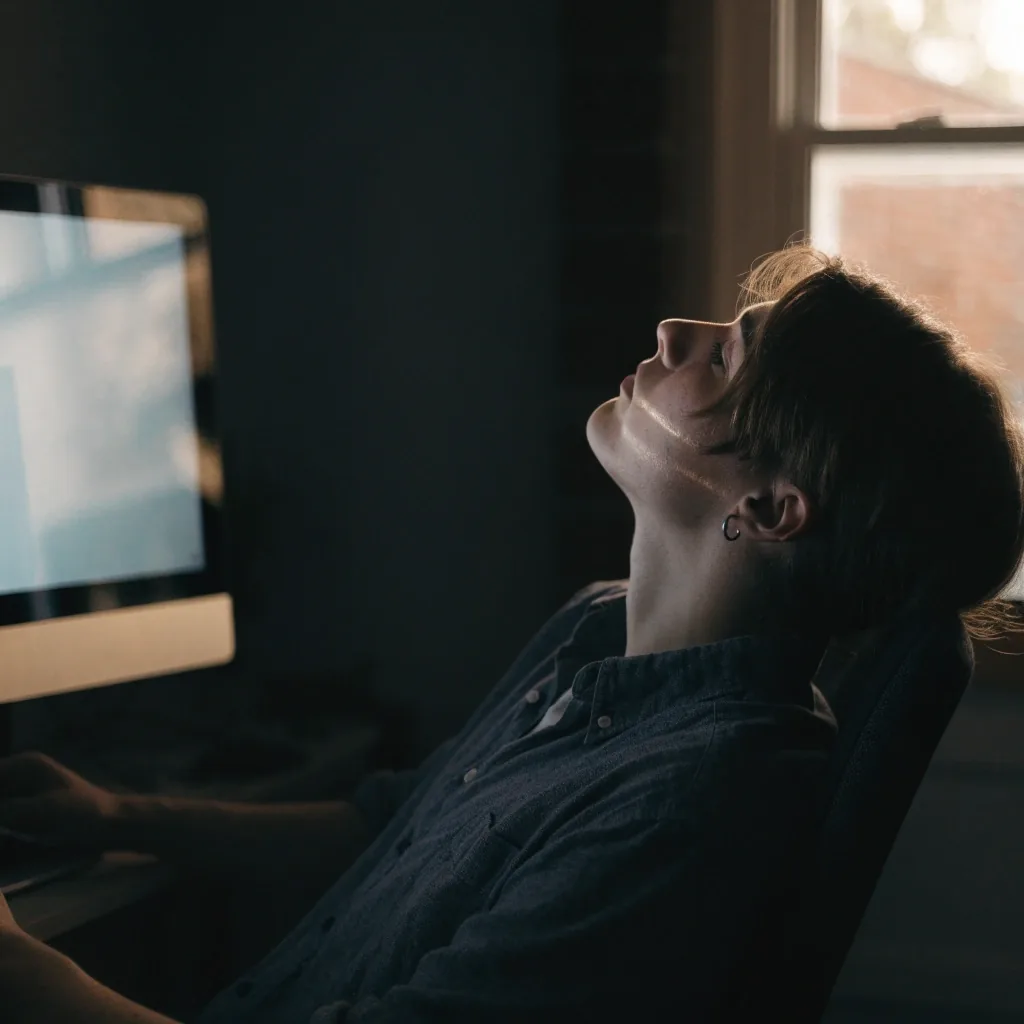
Blurred vision and slow focus
After a long screen session, the eyes can take a moment to catch up with a new distance. This page explains why that lag happens and how to break the pattern.
Signal to watch: blur that clears on a blink
What this page covers
Not damage — a focusing muscle that has held one distance for too long.
Blurred vision after a long screen session is one of the most common complaints in digital eye strain, and one of the most misunderstood. It usually isn't a sign that something has broken. It's a sign that the focusing system has been holding one distance for too long. Below, we go through what near work does to that system, why blur shows up during screen use rather than after it, how difficulty focusing differs from blurred vision, and how to structure your screen sessions so the lag stops building.
- Focus switch Slow to refocus Distance change
- Soft image Blur while reading Often dryness
- Recovery Real distance breaks Every block
The mechanism
What near work does to the focusing system
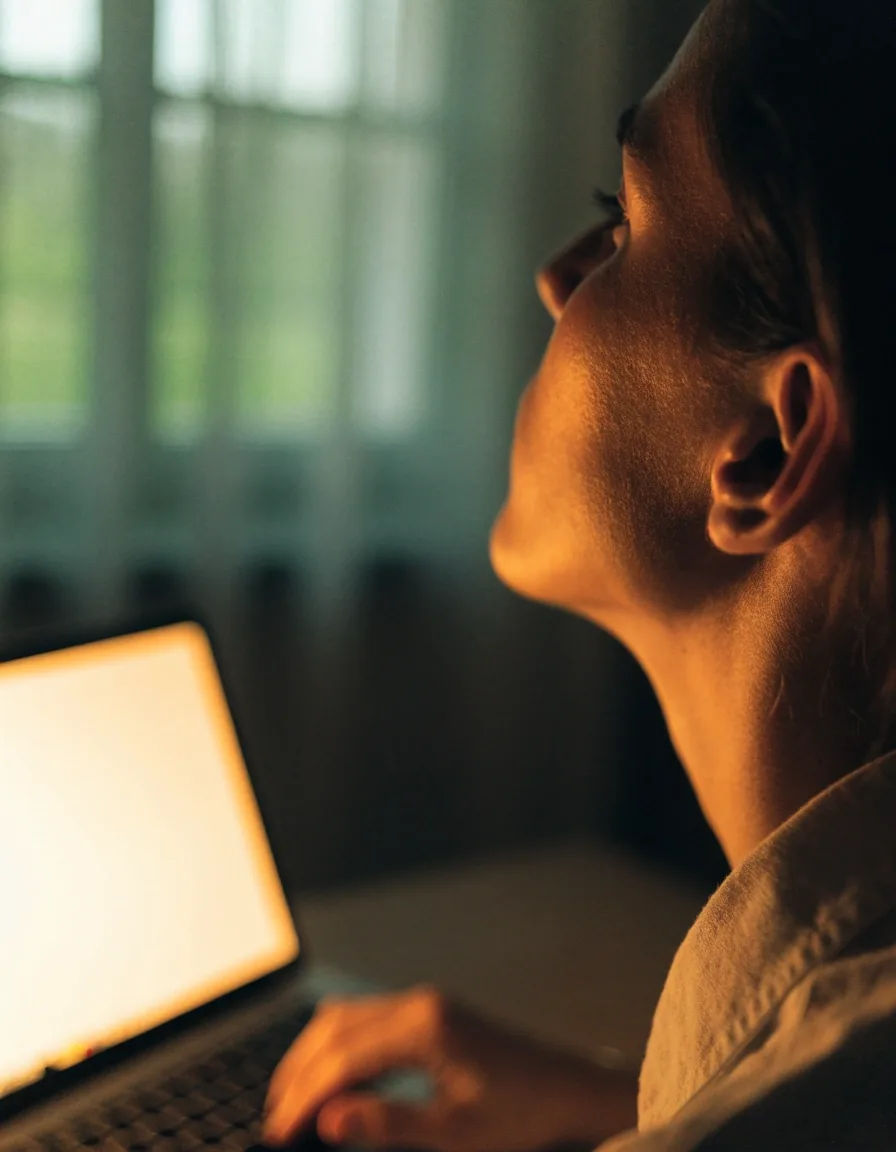
To see something close, a small muscle inside the eye contracts and changes the shape of the lens. To see something far, it relaxes. Screen work keeps that muscle engaged for as long as you're looking at the monitor, which can be hours. It's not a strain in the injury sense, but it is sustained effort without recovery.
When you finally look up, the muscle takes a moment to release, and that moment is the lag people describe as difficulty focusing. The feeling that your eyes need to reset is a fairly accurate description of what's happening.
Two symptoms, two shapes
Difficulty focusing versus blurred vision
These two symptoms are related but distinct, and the distinction is useful when you're trying to work out what your eyes are actually telling you.
The image itself looks soft
The picture never quite resolves. Text may look slightly smeared, edges lose their crispness, and contrast feels lower than usual. A blink sometimes sharpens things for a second or two, which points toward the tear film rather than the focusing muscle.
Clear once you get there — getting there is slow
The image is sharp when it settles, but the switch takes longer than it should, especially between distances. You may notice it most going from the monitor to a whiteboard across the room, or from a phone in your hand to the road ahead.
Then act on that
Both are commonly reported in screen-related strain, and both tend to follow the same pattern: long near work, no breaks, and a focusing system that never gets to relax. The difference is only in what you notice first, and the routine that helps is the same either way.
Timing matters
Why blurred vision appears during, not after
Blurred vision during screen use is often a sign that the surface of the eye is dry rather than a focusing problem. An unstable tear film scatters light slightly and softens the image, which is why blinking sometimes sharpens text for a second or two.
The reason screen sessions dry the eye out is simple enough: people blink less often when they're reading a screen, and the blinks they do take are often incomplete. The tear film thins, the surface stops being perfectly smooth, and light arrives at the retina slightly scattered. If a blink improves your vision even briefly, dryness is likely part of it. If a blink changes nothing, the blur is more likely related to focus, refraction, or something worth having checked.
This is also why blurred vision and difficulty focusing show up together so often. One is a surface problem, the other is a muscular one, and a long session without a pause gives both of them room to build.

Lubricating drops are commonly used when dryness is the driver
Recovery routine
The 20-20-20 rule and focus recovery
The 20-20-20 rule exists largely because of this mechanism. It doesn't need to be exact — the point is a genuine distance change and a genuine pause.
Long enough for the focusing muscle to release and the tear film to recover, not a micro-glance.
A shorter gap is fine. A four-hour session with one pause at the end is not the same thing.
A window, a doorway, or a far wall works. Roughly six metres away is a fair guide.
The test that matters more than the numbers: scrolling to a different app on the same phone does not count, because the distance hasn't changed. Neither does closing one tab and opening another. The eyes need the far focus and the pause, not just the interruption.
Habits over settings
Structuring screen sessions to reduce focus lag
Habits matter more than settings here. Alternating blocks of screen work with short distance breaks is the single most effective structural change, and how you build those breaks depends on what your day actually looks like.
Let calls and errands do the work
If your work allows it, sort tasks so long reading sessions are interrupted by calls or errands. Those interruptions already move your eyes to a different distance, so you don't have to add a separate break on top of them. A desk near a window makes this easier: most of the day's far focus is available without leaving the chair.
Interrupt long reading blocksBuild distance breaks into the study plan
Students preparing for exams can schedule distance breaks into the study plan rather than trying to power through a four-hour session. Treat the break as part of the revision block, not as time stolen from it — a two-minute look across the room at the end of every twenty keeps the last hour of reading as clear as the first.
Look far down the road at set intervals
Drivers using mounted screens benefit from looking far down the road at regular intervals rather than holding a fixed near focus on the device. It is the same distance change as the desk version, done in a place where the trade is already part of the task.
Worth checking properly
When blur isn't from strain
Blurred vision isn't always digital eye strain, and the differences are worth knowing before you decide that a habit change will cover it.
- Compare Blur that stays after you've looked away and rested for several minutes points to something other than screen strain.
- Compare Blur that appears suddenly, affects one eye only, comes with double vision that doesn't resolve, or changes with lighting also sits outside the ordinary pattern.
- Next step If you've never had an eye exam and you're experiencing persistent blur, that's the reasonable next step. Habit adjustments help with comfort; they don't diagnose.
Our team in Jakarta answers questions Monday to Friday, 9:00 AM to 6:00 PM. An eye exam needs a clinician, not a website — we'll point you to that step.
If you wear lenses
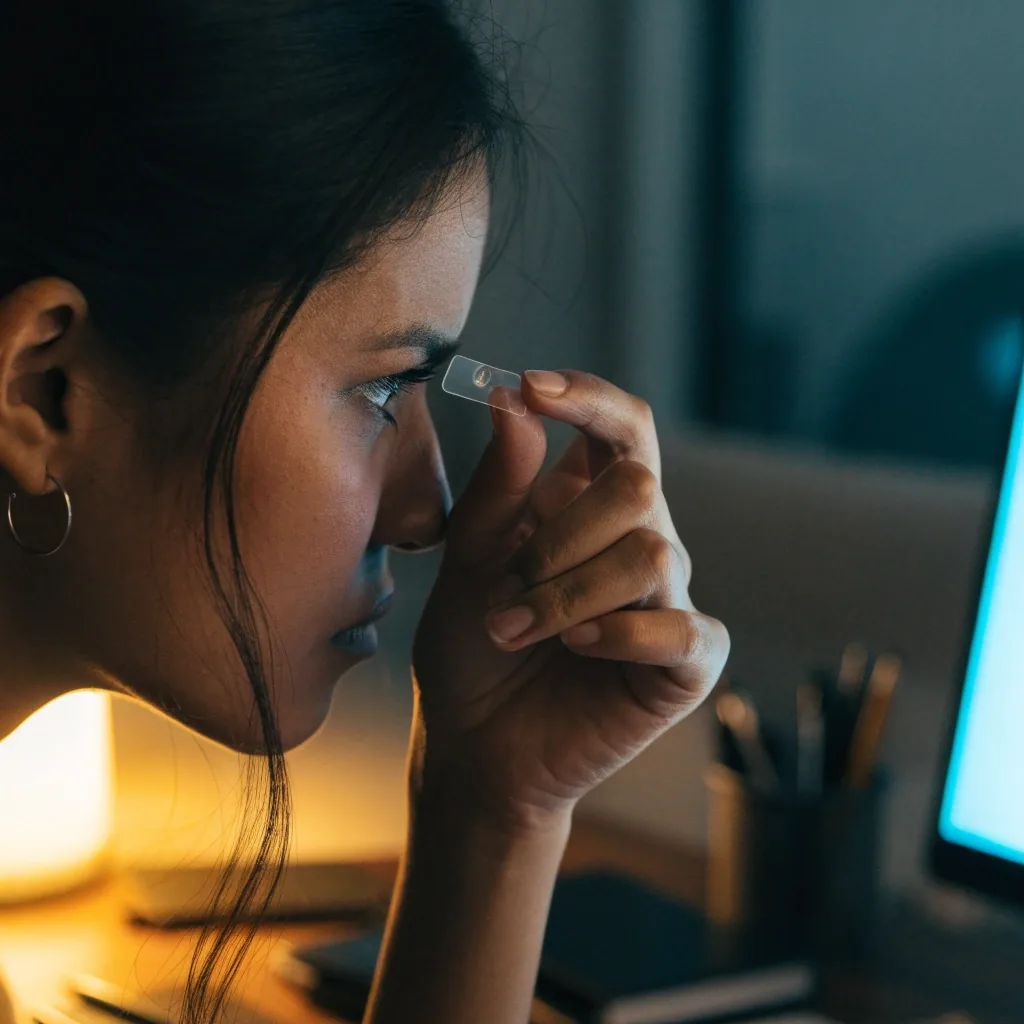
Contact lenses and focus symptoms
Contact lens wearers often notice these symptoms earlier and more sharply, because a dry lens moves on an already-irritated surface. That can produce blur that comes and goes with blinking, plus the burning and watering covered elsewhere on this site.
Preservative-free lubricating drops are commonly used in this situation, since they are the version least likely to add their own irritation on top of what is already there. If you wear lenses and your blur doesn't improve with distance breaks and lubrication, mention your lens schedule when you book an appointment. How long you wear them, how often you swap them, and whether they are worn during screen work are all relevant to the assessment, and they are easy details to forget by the time you're in the chair.
Before you decide
Questions readers send us
These are the questions that come up most often once someone has read the rest of this page and wants to know whether their situation fits.
Is blurred vision after screen time a sign of something serious?
Most blur that appears after a long near-work session and eases once you look into the distance is consistent with ordinary eyestrain rather than injury. It's worth separating out the cases that don't follow that pattern: blur that persists after rest, blur that is one-sided, sudden changes, or double vision that doesn't resolve. Those point to an eye exam rather than a habit tweak.
How do I tell dryness apart from a focusing problem?
Blink deliberately and see what happens. If the image sharpens for a second or two, an unstable tear film is likely part of the problem and dryness deserves attention. If a blink changes nothing at all, focus, refraction, or something worth checking is the more likely explanation. This test is not a diagnosis, but it does split the two most common causes apart quickly.
Does the 20-20-20 rule have to be exact?
No. The numbers are a memorable version of a simple idea: work near, then look far, then come back. Fifteen minutes or twenty-five makes little practical difference. A genuine distance change and a genuine pause make most of the difference, which is why scrolling to a different app on the same phone doesn't substitute for the break.
Should I change my screen settings instead?
Settings help at the margins — sensible brightness, comfortable text size, and a monitor positioned at roughly an arm's length are all reasonable. But the focusing muscle responds to distance and rest, not to a slider. If you can only change one thing, change how your sessions are structured; the settings can follow.
Where does this symptom sit next to the others?
Blur and slow refocusing usually travel with the rest of the digital eye strain picture — burning, watering, headaches, and neck or shoulder tension all tend to appear in the same long-session weeks. If you want to see how the symptoms relate to one another, the overview page lays them out together.
Where to go next
Build the pause into your day
Focus lag responds to structure, not to willpower. If you take one thing from this page, take the distance break: it is free, it takes seconds, and it is the change most people notice first. From here you can read the full daily routine, or work through the rest of the symptoms to see which ones you recognise.
Future Sight Guide
Jl. Jenderal Sudirman No. 52, Jakarta 12190, Indonesia
Monday to Friday, 9:00 AM – 6:00 PM